
Table of Contents
1. Introduction
2. What Is Pharmaceutical Regulatory Strategy?
3. Why Regulatory Strategy Matters in Drug Development
4. The Core Components of a Pharmaceutical Regulatory Strategy
5. Regulatory Strategy in India
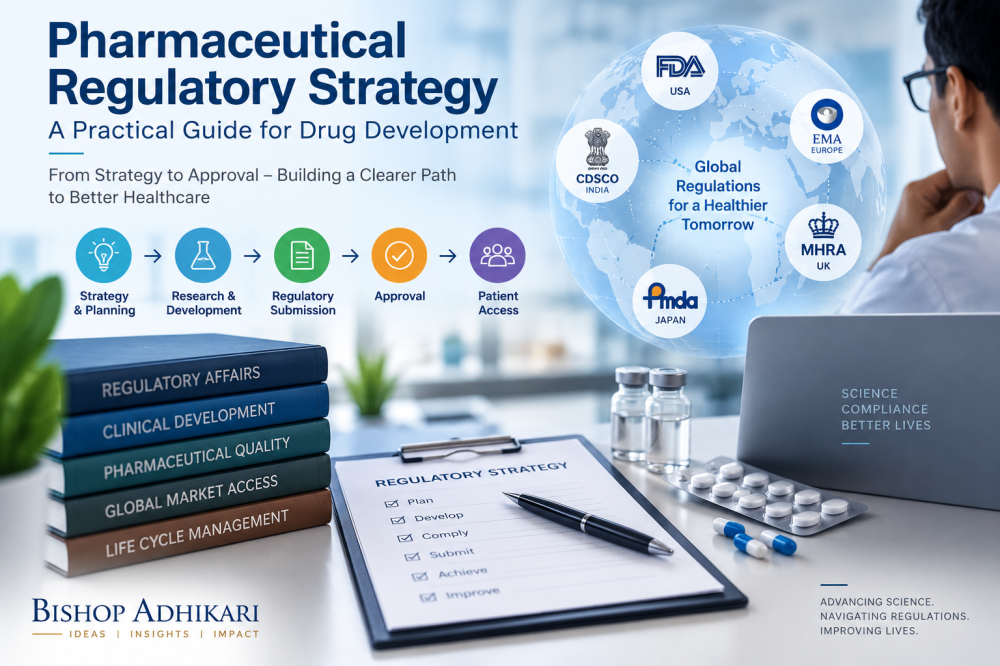
6. Global Regulatory Strategy: India, US, EU, UK, and Japan
7. Common Regulatory Strategy Mistakes
8. A Practical Regulatory Strategy Roadmap
9. The 5-Question Regulatory Strategy Test
10. When Should a Company Seek Regulatory Consulting Support?
11. Conclusion
A pharmaceutical regulatory strategy is a roadmap that helps drug developers turn a scientific idea into an approved medicine by meeting legal and health authority rules.
In pharmaceutical development, regulatory strategy should not be viewed as a documentation exercise that begins shortly before submission. It is a development and decision-making discipline that should influence the product pathway, evidence-generation plan, clinical development, manufacturing strategy, market selection, submission approach, and post-approval lifecycle from an early stage.
What is the most appropriate path to develop, register, and maintain this product in the intended market?
Answer: Regulatory expectations can differ between India, the United States, the European Union, the United Kingdom, and Japan, making early planning essential. Also, the regulatory pathway therefore needs to be considered alongside the scientific and commercial strategy—not separately from it.
Pharmaceutical regulatory strategy is the planned approach used to identify, interpret, and address regulatory requirements throughout the lifecycle of a pharmaceutical product.
The Global Regulatory Agencies like the FDA (Food and Drug Administration), EMA (European Medicines Agency, PMDA (Pharmaceuticals and Medical Devices Agency), Health Canada, Therapeutic Goods Administration (TGA), China Food and Drug Administration (CFDA), and Agência Nacional de Vigilância Sanitária (ANVISA) bring together regulatory intelligence, product classification, development planning, clinical and nonclinical considerations, chemistry, manufacturing, and controls (CMC), submission strategy, regulatory interactions, and post-approval planning.
A practical regulatory strategy should establish:
1. What product is being developed?
2. Which regulatory pathway applies?
3. Where will the product be developed and marketed?
4. What evidence will be required?
5. When should regulatory interactions occur?
6. Which risks could affect development or approval?
7. How should the submission be planned?
8. What happens after approval?
This objective will be planned to answer these questions and needs to be supported. Connect with me; I will support all those questions and create a dynamic system for your organization.
Now come to the next point,
A pharmaceutical program can encounter significant delays when regulatory considerations are introduced too late. Companies without a proper regulatory strategy face substantial risks, including delayed approvals, increased development costs, regulatory setbacks, and potential market access failures. But it can be improved
If this sentence sticks in your mind : "A development team may have strong scientific data but still face challenges if the evidence package does not adequately address the expectations of the intended regulatory jurisdiction." This demonstrates an important principle:
Regulatory strategy is interconnected with the entire development program.
A decision made during early development can influence later regulatory requirements. Similarly, a manufacturing or clinical-development decision can create consequences for the eventual submission.
A regulatory strategy can help organizations:
1. Identify regulatory requirements early.
2. Reduce avoidable development rework.
3. Prioritize critical regulatory risks.
4. Align scientific and regulatory objectives.
5. Plan interactions with regulatory authorities.
6. Prepare evidence appropriate to the intended market.
7. Improve submission readiness.
8. Anticipate post-approval obligations.
The first question that should come to mind is: What exactly is the product?
The answer would be: A clear classification assessment at the beginning can prevent strategic mistakes later.
The second thought should be dose regulatory strategy should be developed with the intended market in mind.
The answer would be: Therefore, market strategy and regulatory strategy should be developed together.
3. Select the Appropriate Regulatory Pathway:
Two questions will be blow your mind: " The strategic question is therefore not simply:
"What form do we submit?"
It is:
"What development and regulatory pathway provides the most appropriate route for this product and intended indication?"
The answer would be: Investigational New Drug (IND) and New Drug Application (NDA)
Regulatory strategy must be connected to the evidence required to support the product. Now the question will come into the picture: what types of data are required to submit (U.S. Food and Drug Administration)?
The answer would be: Nonclinical evidence , Clinical evidence, and Quality/CMC evidence.
The key strategic issue is alignment.
The evidence-generation program should be designed with the eventual regulatory questions in mind.
Questions may include:
1. How will the product be manufactured?
2. Is the process sufficiently controlled?
3. Are specifications scientifically justified?
4. Is the analytical strategy appropriate?
5. Is stability adequately addressed?
6. How will manufacturing changes be managed?
This provides an important foundation for integrating pharmaceutical development and quality considerations into the regulatory strategy.
The answer would be: The International Council for Harmonisation (ICH) provides a series of quality guidelines covering areas .
One of the most valuable components of regulatory strategy is regulatory intelligence.
Regulatory intelligence involves systematically understanding relevant:
1. Regulations
2. Guidance documents
3. Regulatory precedents
4. Agency communications
5. Emerging expectations
6. Competitor developments
7. Changes in regulatory policy
This is particularly important because regulatory environments evolve.
A regulatory strategy should therefore be dynamic rather than static.
For organizations developing or introducing pharmaceutical products in India, understanding the Indian regulatory framework is essential. For investigational new drugs, CDSCO states that applicants submit applications for permission to conduct clinical trials and, where applicable, to import or manufacture investigational new drugs using the prescribed process and documentation through the SUGAM portal.
What does this mean strategically?
An India-focused regulatory plan should consider the product's:
Classification → Development stage → Regulatory pathway → Evidence → Application requirements → Clinical requirements → Manufacturing/quality requirements → Approval → Post-approval lifecycle.
-> USA: FDA states that an NDA should provide the information needed to assess safety and effectiveness, labeling, and manufacturing quality. (U.S. Food and Drug Administration).
-> EU: EMA also makes clear that scientific advice does not guarantee marketing authorization. (European Medicines Agency (EMA)
-> UK: A UK strategy needs to consider the regulatory framework administered by the MHRA.
-> JP: PMDA provides consultation processes for new medicines, including pre-evaluation and clinical-trial-related consultations. (PMDA)
The strategic lesson
A global regulatory strategy should identify common development elements that can support multiple markets while also identifying jurisdiction-specific requirements early.
Even technically strong organizations can encounter regulatory difficulties because of strategic gaps.
1. Starting Too Late
2. Treating Regulatory Affairs as Documentation
3. Ignoring Market Strategy
4. Poor Cross-Functional Alignment
5. Underestimating Regulatory Interactions
6. Failing to Plan for the Product Lifecycle
A simple framework can help organizations organize their thinking:
STEP 1 — Define
Product + Indication + Dosage Form + Route
↓
STEP 2 — Classify
Determine the applicable regulatory category and pathway.
↓
STEP 3 — Select Markets
Identify priority jurisdictions and market-entry sequence.
↓
STEP 4 — Map Requirements
Identify clinical, nonclinical, CMC, quality, safety, and submission requirements.
↓
STEP 5 — Identify Risks
Assess regulatory uncertainties and potential development barriers.
↓
STEP 6 — Plan Interactions
Determine whether and when regulatory or scientific advice may be appropriate.
↓
STEP 7 — Build the Submission Strategy
Establish documentation, evidence, timelines, responsibilities, and submission readiness.
↓
STEP 8 — Prepare for Approval
Address regulatory questions, commitments, inspection considerations, and other requirements.
↓
STEP 9 — Manage the Lifecycle
Maintain regulatory compliance and plan for post-approval changes and ongoing obligations.
Before moving forward with a pharmaceutical development program, an organization should be able to answer five fundamental questions:
1. What are we developing?
Clearly define the product and its intended use.
2. Where do we want to market it?
Identify priority jurisdictions and the intended market-entry sequence.
3. What regulatory pathway applies?
Understand the applicable pathway and requirements.
4. What evidence will regulators expect?
Align the development program with the evidence needed to support regulatory decisions.
5. What could prevent or delay approval?
Identify major regulatory, scientific, manufacturing, clinical, and operational risks early.
If these questions cannot be answered clearly, the regulatory strategy may need further development before significant resources are committed.
Regulatory consulting can be particularly valuable when an organization is:
1. Developing a new pharmaceutical product
2. Entering a new geographical market
3. Planning clinical development
4. Preparing a regulatory submission
5. Reviewing an existing regulatory pathway
6. Establishing or improving quality systems
7. Preparing for an inspection or audit
8. Assessing regulatory gaps
9. Managing complex lifecycle changes
10. Evaluating innovative technologies or development approaches
The purpose of consulting should not simply be to provide more documentation. The real value is helping the organization make better regulatory decisions.
Our team is here to help you make your regulatory journey more effective.
Pharmaceutical regulatory strategy is best understood as a continuous strategic process connecting science, development, quality, regulation, and business objectives. A successful strategy begins with understanding the product and its intended market, selecting the appropriate regulatory pathway, identifying evidence requirements, managing regulatory risks, engaging appropriately with regulatory authorities, and preparing for the entire product lifecycle. For companies operating internationally, the challenge is even greater. A development strategy that works in one jurisdiction may require significant adaptation for another. The most effective organizations therefore do not wait until submission to ask regulatory questions. They ask them early, systematically, and in connection with the scientific and commercial decisions that shape the product.
Frequently Asked Questions:
1. What is pharmaceutical regulatory strategy?
Pharmaceutical regulatory strategy is the structured approach used to plan and manage regulatory requirements throughout the development and lifecycle of a pharmaceutical product.
2. When should regulatory strategy begin?
Ideally, regulatory strategy should begin during early product development and evolve as scientific, clinical, manufacturing, and commercial information becomes available.
3. What does a pharmaceutical regulatory consultant do?
A regulatory consultant can help organizations interpret regulatory requirements, evaluate pathways, identify gaps and risks, develop regulatory plans, support submissions, and provide strategic guidance throughout development and lifecycle activities.
4. How does regulatory strategy differ between India and the US?
The regulatory frameworks, authorities, procedures, application pathways, and evidence expectations differ. India operates under its own statutory and regulatory framework, including the NDCTR 2019, while US drug applications are regulated by the FDA under the applicable federal framework. (CDSCO)
5. Why is regulatory intelligence important?
Regulatory intelligence helps organizations stay informed about relevant regulatory changes, guidance, precedents, and emerging expectations so that development and compliance strategies can be updated appropriately.
Every product and organization presents a different regulatory challenge. Dr. Bishop Adhikari and Team provide professional consulting and advisory support for pharmaceutical, regulatory, scientific, research, healthcare, and innovation-focused requirements.
Discuss Your Requirements → Connect with us.
30 Minutes: Book a Free Consultation → Book Now
For more such content, subscribe to us: Subscribe now